Home / Canola Watch Newsletters / Canola Watch: Heat stress | Canola pods growing?
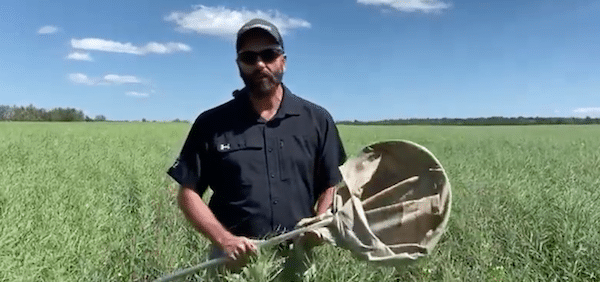
| Seeing lygus in canola? Click the image above to watch a two-minute video featuring Canola Council of Canada Agronomy Specialist Jason Casselman explaining lygus bug scouting and economic thresholds. |
|
How to support max yield as canola enters the homestretch?
The last weeks of the growing season offer critical opportunities to proactively influence yield and protect the crop. Insect scouting (especially diamondback moth, lygus and grasshoppers) is priority one. Insect populations can expand rapidly in hot weather so be continuously vigilant. There may be opportunities to improve crop fertility this year or to gain important knowledge to optimize fertility management next year. Tissue test strong and weak areas of the field. If adding late-season fertility, leave test strips to check ROI. (Thresholds for major canola insects) (Insect distribution and abundance protocols) |
|
Why are canola flowers pale?
The most common reason for pale canola flowers is sulphur deficiency. Even if adequate sulphur exists in the soil profile, it may have been washed out of the root zone by early season moisture, especially if the crop didn’t root deeply. In addition to the characteristic small, pale-yellow flowers, look for small, narrow, often cupped top leaves, pale yellow new leaves, prolonged flowering if the crop has trouble setting seed, short pods with little to no seed set, and patchiness/variability across the field. Read more about sulphur deficiency here.
Less common reasons for pale flowers relate to herbicides:
- Glyphosate applied late and off-label (after the 6-leaf stage) on Genuity (not TruFlex) canola can cause pale flowers. In this case, look for near-white petals of normal size with short stamens that don’t protrude above petals in recently opened flowers. This article describes glyphosate damage to canola’s reproductive parts.
- Drift from group 27 Pyrasulfotole (Infinity) herbicide can turn flowers white. Damage looks striking but is generally minor.
- Cultivar off-types can also cause light-coloured petals.
|
|
Why is canola sprouting in pods?
There are three causes for ‘precocious germination’, or canola sprouting in the pod. We’ve listed them from most to least common for this time of year at average moisture conditions:
- Aster yellows causes all sorts of strange growth abnormalities. Later-season aster yellows infection can appear as sprouting in pods, sometimes without any other obvious symptoms. In many cases, these misshapen or malformed seeds will dry up and blow out of the combine at harvest.
- Drought stress can cause a hormone imbalance that causes seeds to sprout in pods and cut plants to regrow.
- At the end of the season, canola can sprout in a standing row if seed moisture drops down to around 10% moisture then gets wet again (this is much less common in canola than in cereals).
(Sprouting canola seed causes) (Aster yellows) (Sprouted canola seed grading guide) |
|
How does heat stress impact different crop stages?
Ongoing heat continues to take a toll on canola. Here’s how:
- Vegetative stage: heat stress can impact growth rate, nutrient acquisition (if water demands are not met), and the ability of the crop to produce the energy that will ultimately drive seed production.
- Rosette, pre bolting, bolting: heat stress can cause hormonal imbalance
- Flowering: heat stress reduces seed number because the pollen grain is not hydrated on the stigma, which reduces fertility and decreases seed production
- Seed fill: heat stress can decease movement of sugars and other raw material from the mother plant to the developing seed, resulting in smaller seed and potentially lower seed quality.
Yield is based on seed number (determined at flowering) x seed size (determined at seed fill). Seed number contributes more to yield than seed size, so yield is most impacted by heat stress during flowering, especially early flowering. Older varieties are more sensitive to heat stress than newer ones. (Heat at flowering) |
|
 |
|
QUIZ – Stranger things
|
There are strange things found in the mid-day sun by the people who moil for golden crops of canola. (Inspired by poet Robert Service)
Our eyes are drawn to strange insects and afflictions in canola fields this time of year. Agronomy specialists found these things in canola fields this week.
|
|
|
EVENT TOMORROW:
The second day of Saskatchewan’s Crop Diagnostic School: Hosted by Saskatchewan Agriculture and Northeast Agriculture Research Foundation (NARF), July 25 in Melfort, SK. To register, click here. |
|
|
UPCOMING EVENT:
Saskatchewan Disease Training Days: Hosted in partnership between SaskCanola, Agri-ARM and the Canola Council of Canada and free to attend. Members of each of these organizations will be presenting as well as local crop extension specialists and provincial specialists. Topics covered will include disease scouting, identification for the four main canola diseases, and taking samples to submit for confirmation. Register here to attend. Workshops will be held in:
– Outlook, SK, on August 28,
– Melfort, SK, on September 5
– Yorkton, SK on September 12. |
|
|
UPCOMING EVENT:
Registration is now open for the Water Security Agency (WSA)’s Point of Adequate Outlet (PAO) course. To register, contact Heather Davies. Full introductory PAO course dates are as follows:
* Sept 20 online virtual session (9-11am) + Sept 26 field day near Yorkton, SK (9am-3pm)
* Oct 4 online virtual session (9-11am) + Oct 9 field day near Moose Jaw, SK (9am-3pm) |
|
|
REBATE… ONE WEEK LEFT TO CLAIM:
The Saskatchewan Association of Rural Municipalities (SARM) is administering a 50:50 cost-share rebate program for efforts to control ground squirrel populations. The deadline to claim under the 2024-25 program is July 31, 2024. For more information, click here. |
|
|
OPPORTUNITY:
Contribute to valuable research by collecting sclerotia in canola: A new research project examining whether sclerotinia in canola has developed fungicide tolerance needs field samples. Samples from 100 fields are needed in both Manitoba and Saskatchewan. Please collect sclerotia or 2-5 infected stem-pieces in canola fields after harvest, then ship using the address and other information in this pdf. If you have questions, email AAFC Research Scientist Lone.Buchwaldt@agr.gc.ca. Thanks in advance for your help! |
|
|
NEW SCLEROTINIA RISK ASSESSMENT TOOL:
You might have seen CCC agronomy specialist and sclerotinia lead, Chris Manchur, on a recent episode of RealAg’s The Agronomists discussing our new sclerotinia risk assessment tool. If not, here’s a link to view the broadcast. The new tool offers a recommendation about whether or not to spray a canola crop (at 20-50 per cent flower) and an opportunity to assess the spray decision by rating disease severity at maturity (30-60 per cent seed colour change.) It also features an economic calculator and a helpful sclerotinia resource library. Check it out today at CanolaCalculator.ca. |
|
|
CROP DIAGNOSTICS:
Canola Council agronomy specialists and other provincial canola specialists are available to help diagnose issues in crops. However, they need adequate information and good photographs to be able to provide meaningful advice. Here are photography tips and good guidelines for submitting samples. |
|
|
PEST SURVEY and MAPPING:
Each year, surveyors conduct field visits to gather information for insect survey and population maps in Alberta. In addition, producers can fill out this online Cutworm web submission form to report the location and other details about suspected cutworm finds. Use this interactive map of Alberta to view Cutworm survey results. |
|
|
PREVENT HEAT STRESS IN HUMANS:
- Wear light and loose-fitting clothing.
- Drink water when you’re thirsty.
- Take frequent breaks when working in the heat and rotate work tasks to avoid too much exposure to heat.
- Work indoors instead of outdoors, if possible.
- Use shades and sunscreen.
Source |
|
|
SUPPORT:
Are you or is someone you know feeling burnt out, unreasonably stressed or exhausted? Help is available.
– Support lines by province
– Do More Ag Foundation
– Manitoba Farmer Wellness Program |
|
|


